
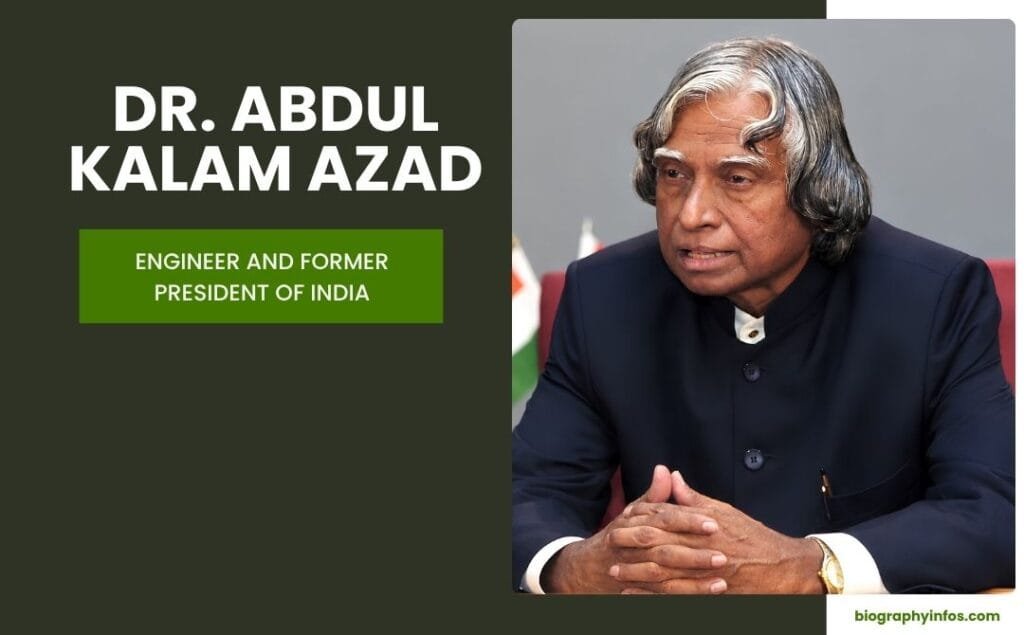
Dr. APJ Abdul Kalam is one of the names that has the power to evoke some respect and affection in the contemporary history of India. Kalam was a man who started from a small fishing village and went on to become the President of India, a man who is a symbol of hard work, humility and vision. For his contributions to the missile and space programs of India, he has been called the “Missile Man of India” and for the effervescent smile he put into public life as president, the “People’s President”. (Wikipedia, Britannica) This article chronicles his life and career, his family and legacy, while maintaining a fidelity to the facts of his biography.
Who is Dr. APJ Abdul Kalam?
Avul Pakir Jainulabdeen Abdul Kalam, popularly called Dr. APJ Abdul Kalam, was an Indian aerospace scientist and statesman, and the 11th President of India from 2002 to 2007. (Wikipedia)
Quick snapshot:
| Detail | Information |
| Full Name | Avul Pakir Jainulabdeen Abdul Kalam |
| Known As | Missile Man of India, People’s President |
| Profession | Aerospace Engineer, Scientist, Author, Statesman |
| Key Organisations | DRDO, ISRO |
| Political Role | 11th President of India (2002–2007) |
| Notable Work | India’s satellite launch vehicle program, missile development, Pokhran-II nuclear tests |
(Source: Wikipedia)
Avul Pakir Jainulabdeen Abdul Kalam, or as he is widely known as- Dr. APJ Abdul Kalam, was an Indian aerospace scientist and statesman who became the 11th President of India on 26 July 2002 and held the position till 28 July 2007. (Wikipedia)
Dr. APJ Abdul Kalam Age
| Born | 15 October 1931, Rameswaram |
| Died | 27 July 2015, Shillong |
| Age at Death | 83 years |
(Source:Wikipedia, Britannica)
His life spanned some of the most significant decades in India’s post-independence history — from the early years of nation-building through India’s emergence as a nuclear and space-faring power.
Dr. APJ Abdul Kalam Height and Weight
There is no reliably documented, officially sourced figure for Kalam’s exact height or weight in his authorised biographies, government records, or established news reporting. Unlike film stars or athletes, this kind of physical statistic was never a matter of public record for him, and any specific numbers circulating online are not traceable to a credible source.
What we do know:
- He was of average build
- He was widely described by those who met him as simple in appearance
- He favoured plain, unpretentious clothing throughout his life (BBC News)
Dr. APJ Abdul Kalam Early Life
Kalam was born in Rameswaram, then part of the Madras Presidency and now in Tamil Nadu, into a Tamil Muslim family. (Wikipedia)
Family snapshot at birth:
- Youngest of five siblings (one sister, three elder brothers)
- Father: Jainulabdeen Marakayar — boat owner and imam of a local mosque
- Mother: Ashiamma — homemaker
(Source: Wikipedia)
The family had once been prosperous Marakayar traders and landowners, with roots said to trace back to Arab traders. However, the construction of the Pamban Bridge in 1914, which connected Rameswaram’s Pamban Island to the mainland, disrupted their traditional ferry and trading business. By the time Kalam was born, the family’s fortunes had declined considerably. (Wikipedia)
Key facts about his boyhood:
- Delivered newspapers to help support the family’s limited income
- Described by teachers as an average scorer overall
- Showed real dedication and curiosity, particularly toward mathematics
- Known for spending long hours absorbed in study
(Source:Wikipedia, Rediff.com)
Dr. APJ Abdul Kalam Family Background
Kalam’s ancestors were once well-off Marakayar traders, a Muslim community found along the coasts of Tamil Nadu and Sri Lanka. Their business involved transporting goods and pilgrims between the mainland, Pamban Island, and Sri Lanka — a trade that collapsed after the Pamban Bridge opened, and the family’s wealth and properties were largely lost by the 1920s. (Wikipedia)
Personal family facts:
- Remained close to his siblings throughout his life, even after achieving national prominence
- Reportedly sent small amounts of money to his elder siblings regularly
- Never married and had no children
- Left no will — his few personal possessions passed to his eldest brother after his death (The Times of India)
Dr. APJ Abdul Kalam Education
| Institution | Qualification | Year |
| Schwartz Higher Secondary School, Ramanathapuram | Schooling | 1950 |
| St. Joseph’s College, Tiruchirappalli | B.Sc. in Physics | 1954 |
| Madras Institute of Technology | Aerospace Engineering | 1960 |
(Source: Wikipedia,The Times of India)
A defining moment during his studies: While at the Madras Institute of Technology, the dean — dissatisfied with the slow progress of a class project — gave Kalam a strict three-day deadline to complete it or risk losing his scholarship. Kalam met the deadline, leaving a lasting impression on both the dean and Kalam’s own approach to discipline and pressure. (Rediff.com)
He also once aspired to become a fighter pilot in the Indian Air Force, narrowly missing selection after placing ninth in the qualifying round when only eight positions were open. (The Hindu)
Dr. APJ Abdul Kalam Career
Early Scientific Career
- Joined the Defence Research & Development Service in 1960
- Worked at the Aeronautical Development Establishment of DRDO, initially designing small hovercraft
- Later worked under renowned space scientist Vikram Sarabhai at the Indian National Committee for Space Research
- Eventually recruited into ISRO
(Source:Wikipedia)
Major Milestones
| Year | Milestone |
| 1969 | Transferred to ISRO; became project director for India’s first Satellite Launch Vehicle (SLV-3) |
| 1970s | Directed Project Devil and Project Valiant, early ballistic missile efforts |
| July 1980 | SLV-3 successfully placed the Rohini satellite into near-earth orbit |
| 1980s | Appointed chief executive of the Integrated Guided Missile Development Programme (IGMDP) |
| 1983-1990s | Led development of the Agni and Prithvi missiles, earning the title “Missile Man of India” |
| 1992–1999 | Served as Scientific Adviser to the Prime Minister and Secretary of DRDO |
| May 1998 | Played a key role in the Pokhran-II nuclear tests alongside Rajagopala Chidambaram |
| 1998 | Co-developed the low-cost “Kalam-Raju stent” with cardiologist Bhupathiraju Somaraju |
| 2002–2007 | Served as the 11th President of India |
| 2007 onward | Returned to teaching; became visiting professor and first chancellor of IIST Thiruvananthapuram |
(Source:Wikipedia, Frontline,The Hindu)
Presidency Highlights
- Nominated in 2002 with rare, broad backing from both the ruling NDA and the opposition Congress (Rediff.com)
- Won the election decisively and was sworn in on 25 July 2002 (The Times of India)
- First scientist and first lifelong bachelor to hold the office of President (Wikipedia)
- Became known as the “People’s President” for his accessibility and frequent interactions with citizens and students (NDTV)
- Chose not to contest a second term in 2007 (The Times of India)
Dr. APJ Abdul Kalam Personal Life
Kalam was known for his integrity and an unusually simple lifestyle for someone who had held the highest office in the country. (Wikipedia)
Lifestyle and habits:
- Lifelong bachelor — never married
- Teetotaler and vegetarian
- Never owned a television
- Typically woke around 6:30–7 a.m. and stayed up until around 2 a.m.
- Enjoyed writing Tamil poetry and playing the veena (an Indian string instrument)
- Listened to Carnatic devotional music daily
Faith and spirituality:
- A practising Sunni Muslim who observed daily prayers and fasted during Ramadan
- Also studied Sanskrit and read the Bhagavad Gita
- Reflected the spirit of interfaith respect instilled by his father in religiously diverse Rameswaram
- Described his meetings with Hindu spiritual leader Pramukh Swami Maharaj as deeply transformative, later writing about the relationship in Transcendence: My Spiritual Experiences with Pramukh Swamiji
Dr. APJ Abdul Kalam Social Media
Kalam passed away in 2015, and there is no verified, officially documented personal presence for him on major social media platforms in the way public figures maintain today.
What did happen on social media, however:
- Around 2012, when speculation grew about a possible second presidential term, his name trended heavily on Facebook and Twitter as citizens campaigned in support of his candidacy (The Times of India)
- His death in 2015 prompted a large outpouring of tributes across social media in India (BBC News)
These were public reactions about him rather than accounts run by him — so it would not be accurate to attribute a personal social media following to Kalam himself.
Dr. APJ Abdul Kalam Controversies
Kalam’s public life was largely free of major personal scandal, but a few episodes drew criticism or debate:
| Issue | What Happened | Source |
| Mercy petitions | As President, he left 20 of 21 mercy petitions for death-sentence commutation undecided, including that of Afzal Guru. He acted on only one — rejecting Dhananjoy Chatterjee’s plea, who was later executed. | Frontline, The New Indian Express |
| Pokhran-II “fizzle” claim | K. Santhanam, the site test director, later claimed the thermonuclear device had underperformed and criticised Kalam for reporting the test as a full success. Kalam and Chidambaram firmly rejected this claim. | Frontline, Hard News |
| Koodankulam nuclear plant | In 2011, Kalam publicly supported the safety of the Koodankulam Nuclear Power Plant, a stance opposed by some local residents and activists. | The Economic Times, The Times of India |
Final Thought
Dr. APJ Abdul Kalam’s life traces an extraordinary arc: from a boy selling newspapers in a small pilgrimage town to becoming one of the architects of India’s missile and space capabilities, and eventually the ceremonial head of the world’s largest democracy.
What set him apart was not just his scientific achievement but the humility and warmth with which he carried it, choosing to spend his final years teaching and engaging with young people rather than retiring from public life. He died as he had largely lived — in the middle of addressing students, delivering a lecture at IIM Shillong on 27 July 2015.
His legacy today lives on in the institutions, roads, awards, and even newly discovered species named in his honour, but perhaps most enduringly in the way he continues to be cited as an example of integrity in Indian public life.
FAQ’S
He is best known for his contributions to India’s missile and space programs, earning him the title “Missile Man of India,” and for serving as the 11th President of India from 2002 to 2007.
He was born on 15 October 1931 in Rameswaram and died on 27 July 2015 in Shillong, at the age of 83, after collapsing while delivering a lecture.
No, he remained a bachelor throughout his life and had no children.
He authored numerous books, including his autobiography Wings of Fire, as well as India 2020, Ignited Minds, Indomitable Spirit, and Transcendence: My Spiritual Experiences with Pramukh Swamiji, among others.
He received India’s highest civilian honour, the Bharat Ratna, in 1997, along with the Padma Bhushan in 1981 and the Padma Vibhushan in 1990, as well as several international honours later in life.
He earned this title during his presidency for his accessibility, his frequent engagement with ordinary citizens and students, and his down-to-earth conduct in an office typically associated with formality and distance.