
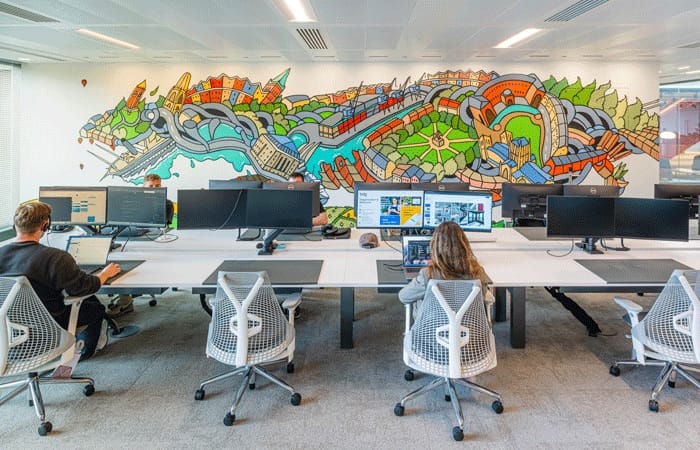
Workplace design is often approached through universal goals such as collaboration, accessibility and employee wellbeing. Yet workplaces also occupy specific cultural and environmental settings. In Australia, recognising that setting means understanding whose Country the workplace stands on and allowing local knowledge to inform the design from the beginning. Without that foundation, even well intentioned efforts can feel generic or disconnected from place.
Local Knowledge Gives Design Meaning
An organisation exploring connecting with Country in the workplace should begin by learning about the Traditional Owners of the area and the continuing relationships between people, land, waterways, language and culture. Country is not an interchangeable design theme. Its stories, protocols and meanings vary between places.
Starting locally helps designers understand which ideas may be appropriate and who has the cultural authority to share them. It shifts the process away from choosing Aboriginal inspired patterns after the main decisions have been made and towards developing a workplace whose materials, layout and character emerge from meaningful engagement.
Community Input Establishes Cultural Authority
Local Aboriginal people should not be treated simply as reviewers asked to approve a nearly completed concept. Their participation is most valuable when it begins during project scoping, before the design direction, budget and timelines become fixed.
A genuine co-design process gives people with cultural knowledge a meaningful role in shaping decisions. It also recognises their expertise, time and intellectual contribution. Clear agreements should establish who will participate, how knowledge may be used, how contributors will be remunerated and which cultural information must remain protected.
Place Shapes Practical Design Decisions
Local context can influence more than artwork. It may guide the orientation of rooms, movement through shared areas, views towards significant landscape features, planting choices, natural materials and the way people gather. These decisions can make cultural recognition part of the workplace’s everyday operation rather than an isolated display.
Environmental context matters as well. Light, climate, vegetation and seasonal conditions differ widely across Australia. Responding to those characteristics can create spaces that are more comfortable and distinctive while reducing reliance on a standard design applied in every location.
Context Prevents Generic Representation
A national organisation may understandably want consistency across its offices, but consistency should not erase local identity. Repeating the same artwork, language or visual motifs at every site can lead to cultural homogenisation, presenting diverse Aboriginal cultures as a single, uniform identity.
A stronger approach keeps shared organisational principles while allowing each workplace to reflect its own Country. Brand colours, accessibility standards and functional requirements can remain consistent, while cultural expression develops through local relationships. This balance supports cohesion without turning inclusion into a corporate template.
Local Design Supports Everyday Belonging
Workplace design communicates who has been considered, even when no formal message is displayed. Local language, commissioned artwork, culturally informed gathering areas and visible recognition of Country can help Aboriginal and Torres Strait Islander employees and visitors feel that their presence is understood rather than added as an afterthought.
Design cannot create cultural safety by itself. It must be supported by respectful behaviour, informed leadership and sustained relationships. However, physical surroundings can reinforce those commitments. They give practical visibility to the relationships, respect and opportunities commonly expressed through a Reconciliation Action Plan.
A Workplace Should Belong Where It Stands
Beginning with local context produces workplaces that are more culturally grounded, environmentally responsive and meaningful to the people who use them. The essential question is not which Indigenous elements can be added to a finished space, but what the workplace can become when Country and community help shape it from the outset.