
Introduction
In the realm of high-end manufacturing, engineers and procurement specialists consistently face a common dilemma with complex geometric parts: traditional single-process CNC turning or milling falls short. The requirement for multiple machines and repeated setups leads to accumulated errors, extended production cycles, and prohibitively high overall costs.
The root cause lies in the discrete manufacturing workflow. Transferring and re-fixturing a part between different machines introduces repeated tool-setting inaccuracies and clamping stresses, while adding significant coordination and management overhead. This severely delays the journey from R&D to volume production.
This article provides an in-depth analysis of how CNC turn-mill machining technology serves as an integrated solution. By completing turning, milling, drilling, and tapping operations in a single setup, it fundamentally addresses these pain points, achieving an optimal balance of precision, efficiency, and cost.
How Does CNC Turn-Mill Machining Work, and Why Does It Guarantee Ultra-High Precision?
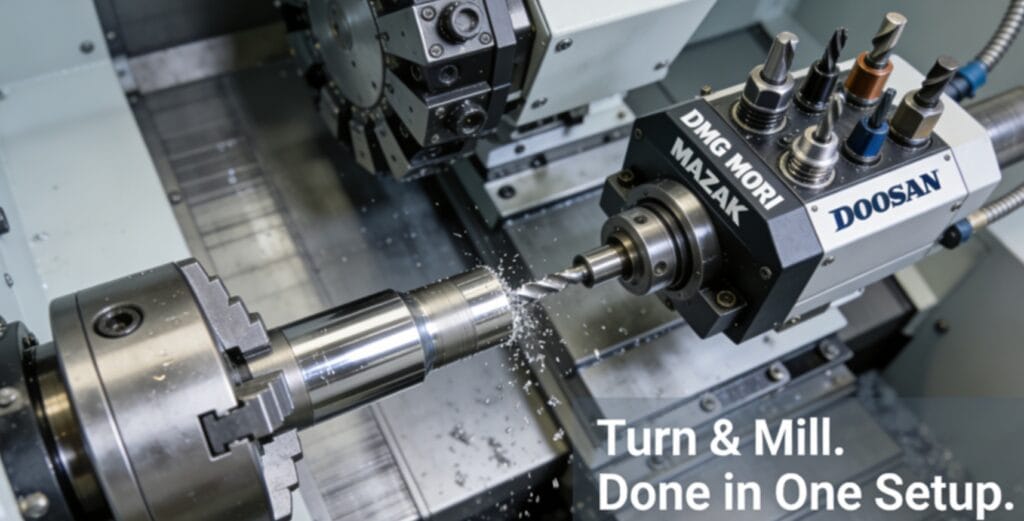
A CNC machining turningcenter integrates the functions of a lathe and a milling machine into one platform. The core principle involves clamping the workpiece once on the main spindle (capable of high-speed rotation), while the machine is equipped with a powered tool turret or a sub-spindle. This allows rotating tools on the turret to perform milling, drilling, and other operations on the workpiece, whether it is rotating or stationary, effectively combining the CNC turning process with milling.
The Foundation: Single-Setup Machining
The core accuracy of turn-mill machining stems from the “single-setup” principle, where the entire part is completed in one clamping. This eliminates the repeated datum re-establishment required in traditional multi-machine workflows, removing the primary source of accumulated positioning error.
Powered Tooling Integration
A rotating, powered tool turret enables this by bringing live spindle functionality to the lathe. It allows for operations like milling and drilling to be performed without unclamping the workpiece, enabling true multi-process integration in one cycle.
Multi-Axis Interpolation
Combined with multi-axis (X, Y, Z, C) contouring control, the powered tools can machine complex off-center and 3D features on the rotating part, seamlessly blending turning and milling geometries.This integrated operation is what allows for the consistent achievement of micron-level tolerances demanded forprecision turning parts. Industry research confirms that minimizing setups is decisive for enhancing final geometric accuracy, as it prevents the stacking of individual fixture and alignment errors.
How Do Turn-Mill Services Simplify the Manufacturing of Complex, Non-Rotational Parts?
Traditional manufacturing workflows often struggle with complex components. Consider shafts or sleeves featuring eccentric holes, cross-holes, flat surfaces, wrench flats, or axial threads. The conventional approach requires completing the rotational body on a lathe before transferring to a milling or drilling machine for secondary features—a cumbersome and coordination-heavy process.
Professional CNC turning and milling services simplify this complexity entirely. By seamlessly switching between turning and milling modes within a single program, operations like OD turning, slot milling, drilling eccentric holes, and tapping side threads can be performed consecutively on the same machine. This not only drastically streamlines the process flow but, more critically, guarantees the positional accuracy between features.
This capability is vital for high-stakes industries. For instance, a bone screw may require perfect threads and a specialized drive recess, while an aerospace fitting needs precision threads and sealing faces. Selecting a supplier certified to standards like ISO 13485 (Medical Devices Quality Management) and AS9100D (Aerospace Quality Management) is key to successfully manufacturing such high-complexity, high-reliability parts.
How Does Turn-Mill Machining Provide a Seamless Path From Prototyping to High-Volume Production?
Agility for Prototyping and Low-Volume Phases
During prototyping, the technology’s programming flexibility is key. Engineers can quickly verify and iterate designs, adjusting parameters and optimizing toolpaths on the same machine. This accelerates development by eliminating delays from re-fixturing on separate equipment.
Efficiency and Consistency for Volume Production
This integrated production model excels in high volume CNC machining, saving significant space and labor while reducing work-in-process inventory. It is ideal for orders requiring high volume precision turned parts with complex features, as the single-setup process ensures dimensional consistency from the first piece to the last.
Integrated Production Advantages
Once stable, the process excels in high volume CNC machining. Its integrated approach saves significant floor space and labor compared to multiple single-purpose machines, while drastically reducing work-in-progress inventory.
Ensuring Large-Scale Consistency
This makes it ideal for high volume precision turned parts with added features. The single-setup logic guarantees unwavering dimensional consistency from the first part to the ten-thousandth, ensuring reliable quality at scale.
How to Evaluate and Select a Reliable Turn-Mill Machining Service Provider?
Selecting a reliable turn-mill partner requires a holistic evaluation. First, assess their technical foundation: the capability, precision, and maintenance of their multi-axis machinery. Secondly, verify robust quality systems like ISO 9001:2015, which guarantee process reliability beyond mere certification. Equally critical is advanced in-house metrology, including CMMs and 3D scanners, to validate that every part meets design intent. Finally, while some search for “CNC milling services near me,” prioritize digital collaboration—efficient online communication, instant quoting, and real-time tracking—over simple geographic proximity, as this responsiveness is key to a successful partnership.
Beyond Metals, What Specialized Materials Can Turn-Mill Machining Handle?
Modern CNC turn-mill machining expertly processes a vast range of materials beyond common metals, including high-strength, difficult-to-machine alloys like titanium and Inconel, advanced engineering plastics such as PEEK which require careful thermal management, and composites like CFRP that need specialized techniques to prevent delamination. Successfully working with these diverse materials tests a provider’s foundational experience and technical know-how more than just machine capability. Therefore, partnering with a supplier possessing deep material-specific expertise—offering comprehensive support from DFM to process optimization—is a critical, value-added competency within professional CNC turning and milling services.
Conclusion
In summary, CNC turn-mill machining represents the inevitable trend in precision manufacturing toward integration and efficiency. By overturning the traditional multi-operation combine model, it achieves high-precision, high-consistency manufacturing of complex parts on a single platform. This not only unlocks greater design freedom for engineers but also delivers significant efficiency gains and cost optimization for project managers.
If you are seeking a breakthrough in the manufacturing approach for a complex part, or wish to evaluate if an existing project could benefit from turn-mill handcraft for cost and efficiency gains, consulting a professional precision manufacturing partner for a feasibility analysis and instant quote tailored to your design is the first step toward successful production.
H2:Author Biography
This article was contributed by a senior engineer with over 15 years of experience in the precision manufacturing field. Having long served demanding industries such as automotive, aerospace, and medical devices, the author possesses a deep understanding of the application and process optimization of advanced CNC machining technologies, including multi-axis turn-mill machining. The author is currently associated with CNC Protolabs, dedicated to providing global customers with end-to-end precision manufacturing solutions from rapid prototyping to volume production.
FAQs
Q: What industries are CNC turn-mill machining primarily suitable for?
A: Its high precision and complex part handling capability make it widely applicable in aerospace (engine components), medical devices (implant housings), automotive (transmission parts), robotics (joint components), and high-end electronics (heat sinks)—fields that demand complex geometries and stringent tolerances.
Q: Compared to separate turning and milling, how much cost can turn-mill machining save?
A: Cost savings vary by part, typically realized through reduced machine occupancy, lower manual setup time, decreased WIP inventory, and lower scrap rates from repeated setups. Overall, for complex parts, total costs can be optimized by 20%-40%, with production lead times shortened by 30%-50%.
Q: What level of precision can turn-mill machining achieve?
A: Modern high-end turn-mill centers can achieve extreme precision, for example, turning diameter tolerances of ±0.005mm and milling positional accuracy within 0.01mm. The achievable precision depends on machine grade, process planning, and environmental control. Selecting a supplier with a rigorous quality system is key.
Q: My product is currently low-volume but may scale up. Is a turn-mill solution suitable?
A: Extremely suitable. Turn-mill machining offers high flexibility, allowing quick response to design changes at low volumes. When transitioning to mass production, stabilized programs and integrated production enable easy scale-up without reconfiguring production lines, making it an ideal solution supporting the journey from prototype to volume.
Q: How do I start a turn-mill machining project?
A: First, provide the 3D CAD model (e.g., STEP format) and drawings of the part. A professional service provider will perform a manufacturability analysis, offering feedback and quotes regarding materials, tolerances, post-processing, etc. Once requirements and expectations are clear, the trial production phase can begin.
Read More –